
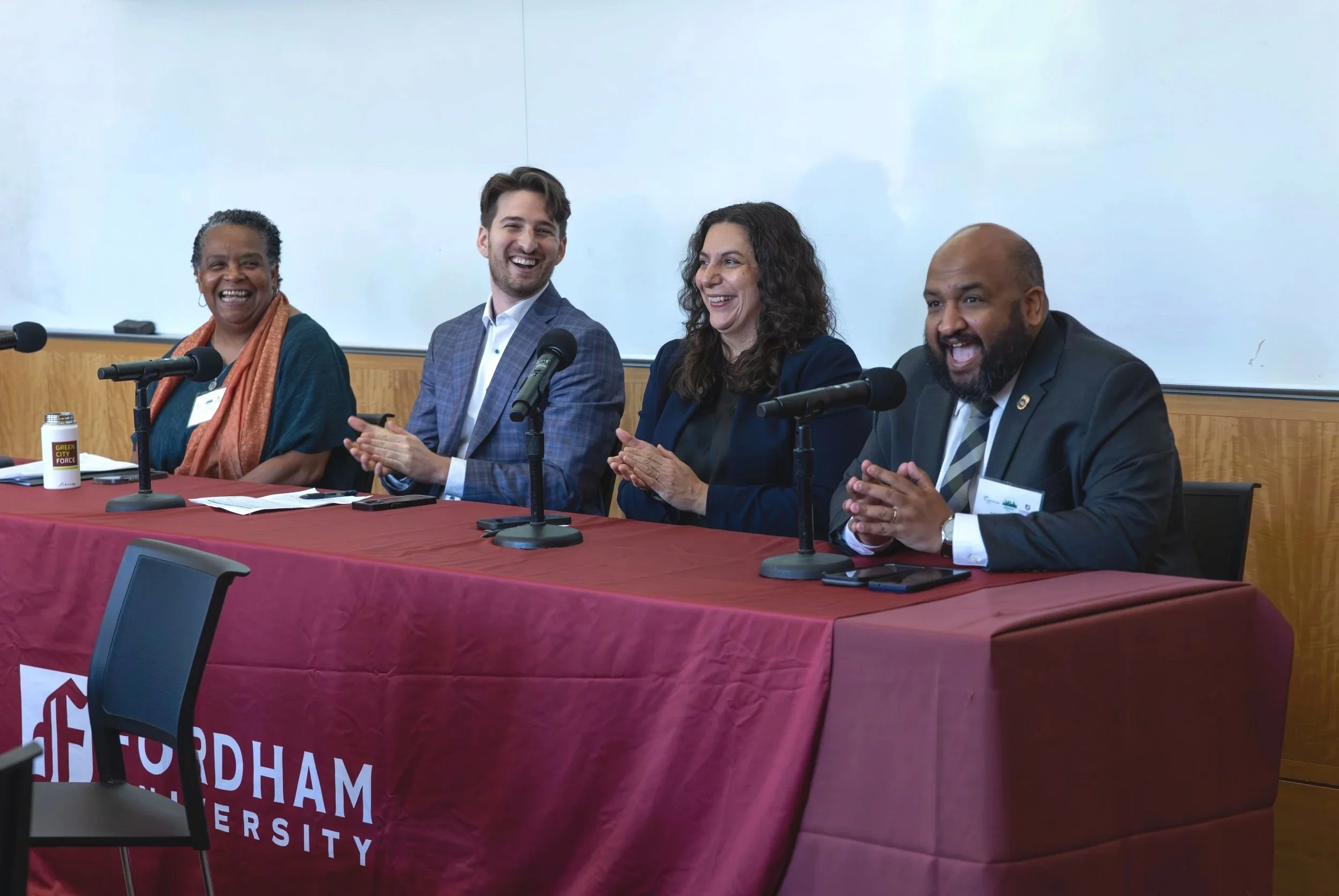
Pictured from left to right: Tonya Gayle, Executive Director, Green City Force; Nathan Berger, Program and Policy Officer at Robin Hood Foundation; Melissa Enoch, Assistant Commissioner, NYC Department of Environmental Protection Bureau of Environmental Planning & Analysis; Ahmed Tigani, Commissioner, NYC Department of Buildings
Building a Workforce Infrastructure for the Green Transition: Recommendations from the Green Economy Network
Our Recommendations for Mayor Mamdani
Establish a centralized Workforce Authority with enforcement power: Create a Workforce Authority1 within City Hall to set citywide standards and align procurement across 21 relevant agencies to ensure high-quality career outcomes. This Workforce Authority will move beyond parallel programming by integrating local hiring mandates and wage benchmarks directly into climate-related contracts, while requiring mandatory reporting on long-term retention and job quality.
Launch the 500-school retrofit pilot: Scale a major infrastructure initiative to retrofit 500 public schools, generating thousands of jobs and creating structured training pipelines for students and local residents. These schools will function as “living labs” where building systems like heat pumps and solar arrays serve as hands-on learning tools, supported by direct-entry agreements with building trades and tiered training programs for both youth and adult learners.
Implement a sustainable financing framework for the clean energy workforce pipeline: To avoid new tax-levy spending, the city should classify workforce delivery costs—such as recruitment and screening—as project management soft costs within capital budgets, allowing them to be financed through long-term infrastructure bonds. This sustainable model should be further bolstered by capturing Local Law 97 noncompliance penalties and aligning city projects with state and federal incentives, including NYPA clean energy funds and the New York State Sustainable Futures funding, to offset the costs of a robust clean energy talent pipeline.
1The call for a centralized Workforce Authority, or “czar,” echoes similar calls from our peers, particularly Center for an Urban Future’s 5 Ideas for How the Mamdani Administration Can Strengthen Workforce Development, which JobsFirst NYC partnered on.
Establish a Workforce Authority with Enforcement Power
New York City should create a Workforce Authority housed in City Hall to coordinate workforce strategy across relevant agencies and embed workforce standards into major public investments. Reporting to a deputy mayor, the authority would serve as the city’s central owner of workforce outcomes, aligning policy, procurement, and implementation across agencies. The Workforce Authority would function as the operating system through which agencies are managed and made interoperable. Its role would be not to deliver programs but to ensure consistent standards, agency alignment, and the enforcement of workforce outcomes.
Core Functions
Citywide Workforce Standards
The Workforce Authority would establish consistent standards for:
Job quality and wage benchmarks
Local hiring and recruitment expectations
Employer engagement practices
Retention and advancement metrics, including six- and twelve-month retention and wage progression
These standards would apply across workforce initiatives connected to city-funded projects, including clean energy implementation.
Procurement and Contract Alignment
The authority would ensure that workforce standards are embedded into procurement and capital delivery processes by:
Aligning workforce language across agency RFPs and contracts
Linking contractor performance to workforce outcomes such as retention and advancement
Establishing enforcement mechanisms to prevent low-road contracting practices
Requiring RFPs to include a dedicated capitalizable cost category for workforce delivery
Embedding workforce expectations directly into procurement would ensure that workforce goals are integrated into project delivery rather than treated as parallel programs. By classifying workforce delivery as a capitalizable cost category, the city would accord human infrastructure the same long-term valuation as physical assets, ensuring that the development of a skilled local workforce is recognized as a permanent investment in the city’s economic resilience.
Community Hiring and Environmental Justice Priorities
Major projects should require partnerships with community-based organizations to allow access for communities most impacted by environmental and economic inequities.
The Workforce Authority would:
Establish hiring priorities for environmental justice ZIP codes.
Require community-based workforce organizations to serve as funded partners responsible for outreach, screening, training, placement, and retention support.
Set minimum targets for local hires in entry-level and career-track roles.
Require public reporting on hiring geography, wages, and retention outcomes.
Cross-Agency Coordination
Workforce initiatives in New York City currently span multiple systems without a central coordinating entity. At the time of this report, approximately 21 city agencies explicitly managed workforce development funding and programs. The Workforce Authority would align planning and implementation across key agencies, including:
Department of Small Business Services
New York City Public Schools
City University of New York
New York City Economic Development Corporation
Mayor’s Office of Climate and Environmental Justice
This coordination would ensure that education pipelines, training programs, and hiring opportunities are aligned with major capital and sector investments.
Demonstrate the Model Through the 500-School Retrofit Initiative
Mayor Mamdani’s proposed 500-school retrofit offers a key opportunity to demonstrate how coordinated workforce governance can connect climate investment with career pathways. School retrofits sit at the intersection of climate policy, capital planning, procurement, and education systems, making them an ideal pilot for a coordinated workforce strategy. While the mayor’s platform highlights the role of unions in delivering this work, a coordinated workforce approach would ensure that the learning, training, and career mobility pathways needed to connect New Yorkers into these jobs are intentionally built alongside the projects themselves.
A workforce-aligned retrofit initiative could generate 500 to 2,500 paid jobs and work-based learning placements, while building long-term pipelines into growing climate and infrastructure careers. With clear coordination across agencies, education systems, unions, and training providers, retrofit projects would serve not only as infrastructure upgrades but also as structured entry points into union apprenticeships and related career pathways.
Pilot retrofit schools could also function as “living labs,” where building systems and climate technologies are designed to support hands-on learning for students and workforce trainees. These spaces could provide ongoing opportunities for observation, training, and workforce development tied directly to real infrastructure projects.
Strategic Vision: Infrastructure as a Career and Economic Mobility Engine
Impact: A workforce-aligned retrofit initiative would generate 500 to 2,500 paid jobs and work-based learning placements.
Pipeline goal: Beyond the immediate construction, this initiative would build long-term pipelines into growing infrastructure careers through structured entry points into union apprenticeships.
The “living lab” concept: Pilot schools would function as living labs, with building systems (solar, heat pumps, etc.) designed for hands-on student observation and workforce trainee instruction.
Lead agency: Workforce Authority (in coordination with the New York City School Construction Authority, New York City Public Schools, and GEN)
The Three-Tiered Delivery Model
To maximize the utility of the “living lab” approach while ensuring school security and operational continuity, the initiative would differentiate learning opportunities by age group, timing, and funding source:
Tier 1: Integrated K–12 learning (foundational, delivered during in-school hours)
Focus: General climate literacy and career awareness.
Implementation: Students monitor the school’s heat pump efficiency and energy dashboards during science/STEM periods.
Funding: Standard public school curriculum and teacher professional development budgets, in conjunction with the rollout of New York State Personal Finance and Climate Change Education requirements.
Tier 2: Modern youth apprenticeships (advanced, delivered through a hybrid model)
Focus: Paid, credit-bearing vocational training for high school juniors and seniors.
Implementation: Modeled on the Career Readiness and Modern Youth Apprenticeship. Students spend half-days on site with the retrofit contractor.
Pathways: Direct credit toward GPRO and OSHA-30 certification, along with clear pathways into union jobs.
Tier 3: Community workforce training (technical, delivered after hours and on weekends)
Focus: Adult residents, career changers, and out-of-school youth.
Implementation: Utilizes school mechanical wings and shared equipment outside school hours, on weekends, or during summer sessions.
Role of GEN: Community-based organizations within GEN would serve as funded training providers, ensuring that the curriculum is aligned with the technical needs of the retrofit project.
Union Alignment and Direct Entry
To fulfill Mayor Mamdani’s mandate for high-road labor standards, the Workforce Authority could formalize direct-entry agreements with the Building and Construction Trades Council. This would ensure that student and community pathways lead directly to union apprenticeships in the specific trades performing the school retrofits:
IBEW Local 3: Training on school solar energy systems, electric vehicle (EV) charging, and load management.
UA Local 1 and Local 368: Training on school heat pumps and thermal energy networks.
NYC District Council of Carpenters: Training on envelope weatherization and high-performance insulation.
Laborers’ Local 79: Training on general green construction and hazardous material abatement.
Operational Design and Standardized Pathways in Environmental Justice Communities
Every retrofit project in environmental justice communities could follow a mandatory, four-step workforce pipeline:
Outreach: Led by GEN workforce partners within the relevant ZIP codes.
Screening: Pre-employment training and technical vetting.
Placement: Direct placement into paid entry points (internships, pre-apprenticeships, and transitional roles) embedded in the retrofit contract.
Retention: Six to twelve months of career navigation and support services.
Shared Training Infrastructure and High-Need Areas
Because specialized equipment is often too costly for individual programs to maintain, the city could establish centralized training and resilience hubs within pilot schools. These hubs would focus on high-need sectors identified by the Green Economy Action Plan:
Building efficiency and advanced HVAC
Electric vehicle charging infrastructure
Building automation and maintenance.
Implement a Sustainable Financing Framework for the Green Workforce Pipeline
Given the city’s projected budget shortfall, the retrofit initiative is designed to avoid new tax-levy spending by utilizing capitalized labor principles. By shifting workforce development from a social service expense to a project delivery investment, the city could fund these essential functions through its $6B+ annual capital budget and existing external revenue streams.
Workforce Soft Cost Capitalization
The city should classify community outreach, screening, and retention services as project management soft costs within capital budgets.
Mechanism: Like architectural fees or site inspections, these workforce functions are essential to the successful delivery of the physical asset.
Impact: This would allow workforce coordination to be financed through long-term infrastructure bonds rather than the operating budget, protecting the general fund during deficit cycles.
Procurement Alignment and Contractor Cost-Sharing
To ensure that workforce goals are integrated into project delivery rather than treated as parallel programs, the city should embed workforce expectations directly into the procurement process:
Requirement: RFPs should require contractors to demonstrate funded partnerships with GEN member community-based organizations and workforce training providers for recruitment and retention.
Efficiency: By embedding these costs into climate-related procurements, the city would leverage contractor budgets to deliver community outcomes as a core project requirement.
Inter-Agency Coordination and Administrative Efficiency
The Workforce Authority would serve as the central coordinating entity for aligning planning across 21 city agencies involved in workforce development:
Mechanism: This coordination would help ensure that education pipelines and training programs are synced with the city’s $6B+ annual capital spend.
Impact: By reducing redundancy and administrative waste across agencies, the city would optimize its current budget and ensure that existing training dollars are directed toward projects with guaranteed capital funding.
Alternative Revenue and External Alignment
The retrofit initiative could further offset costs by tapping into dedicated green economy funding:
Local Law 97 penalties: A portion of Local Law 97 noncompliance penalties could be directed to support training infrastructure and “living lab” retrofits. Additional Department of Buildings noncompliance penalty funding streams include Local Laws 84, 133, 87, 88, 33, and 95.
State and federal funding alignment: City project requirements could be aligned with New York State climate funding and federal green energy incentives, including:
New York Power Authority’s $12M for EV maintenance and clean energy career training
New York State’s $1B Sustainable Futures funding for renewables, building decarbonization, thermal energy, and clean transportation.
Public-private partnerships: The city could draw on GEN to help manage and support shared training infrastructure, allowing the cost of specialized equipment to be shared with industry partners and workforce providers.
Partner on Systemic Workforce Solutions
Building a coordinated green economy requires active participation from across the workforce, education, and industry sectors. We invite you to collaborate with the Green Economy Network to help implement these governance and financing models.
To learn more and to support these recommendations, contact Malia Darby at mdarby@jobsfirstnyc.org.